




50 frequently asked questions about dental implants
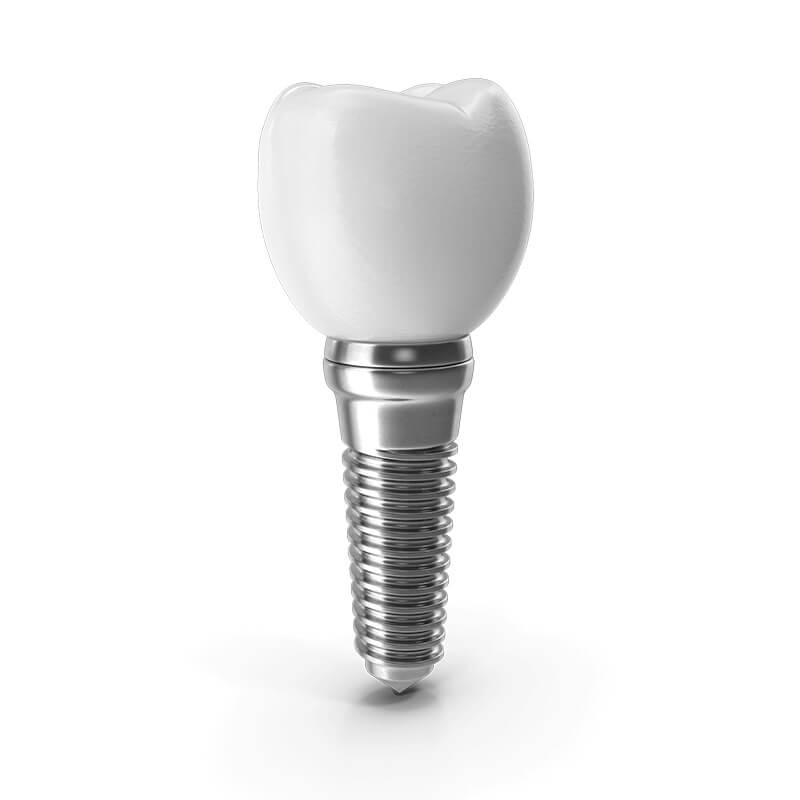

- Titanium:is the most commonly used in dental implants. It is a biocompatible material with the body, that is to say that it does not produce rejection, and it binds to the body by osseointegration producing a strong and stable union.
- Zirconium: is a ceramic material, which also offers excellent results by integrating perfectly into the maxillary bone. It is used in case of patients allergic to titanium.
It is composed of three parts:
- The implant itself which is cylindrical in shape and is threaded into the bone replacing the root of the tooth.
- The pillar or abutment which is the piece that connects the implant to the dental crown and serves as a union between these two parts.
- Crown The visible part of the tooth that will replace the function and esthetics of the missing natural tooth crown.
The success rate is 96.3% to 100% success rate in an estimated time of 3 to 4 years. And in a range of 94.8% to 98% within 5 to 10 years of treatment. So Sonrisa Para Todos offers a lifetime guarantee on dental implants.
Depending on the region where they are placed:
- Alveolar Implants:are the most commonly used and are inserted into the upper or lower jaw bone that surrounded the missing teeth.
- Zygomatic Implants: when the alveolar bone of the upper jaw is insufficient due to severe bone loss, implants are attached to the cheek bone called the zygomatic bone.
- Pterygoid implants:another alternative to the lack of alveolar bone in the upper jaw is to fix the implants in the pterygoid processes, located behind the maxillary molars.
- Immediate load dental implants or also called one-stage implants are those implants that after being placed in the same intervention a fixed provisional prosthesis is placed.
- Two-stage dental implants or also called late loading are formed by two separate pieces; one that is placed inside the bone that will replace the root of the missing natural tooth, and another called abutment and is placed on the first piece that will be where the crown or fixed bridge is supported.
Immediately after the immediate load implants are placed, a fixed provisional prosthesis is cemented in the same intervention. This type of implants are known to promote bone tissue healing and osseointegration providing aesthetic and functional advantages when loaded with a temporary fixed prosthesis. Therefore, the patient can eat and smile from the same day of surgery. The definitive fixed prosthetic rehabilitation can be carried out in a shorter period of time compared to two-stage dental implants.
The advantage of this type of implant is that it is left to heal for several months (approximately 3 to 6 months depending on the case) to allow the osseointegration (integration of the dental implant to the bone) to be generated completely, and after this time place the abutment and continue with the fixed prosthetic rehabilitation.
Both techniques are effective and are often used, the application of each will depend on each particular case.
When the prosthetic treatment is screwed to dental implants, it is easier to dismantle the prosthesis either for hygiene reasons or because of problems that may arise in the crowns.
In the case of prosthetic treatments cemented to dental implants, there is a better stability of the prosthetic structure and the procedure is simpler, allowing the prosthesis to be changed or replaced if necessary.
In all those cases in which there has been the loss of one or more teeth and the bone condition is adequate to place the dental implant. The placement of the dental implant stops the resorption or alveolar bone loss, and restores both the lost function and esthetics.
It is no secret that smoking causes damage and alterations to our organism, and the oral cavity is not exempt from these effects, putting at risk the success of a dental implant treatment, since it not only hinders the generation of osseointegration but also decreases the normal healing process, increases the possibility of infections and greatly favors the accumulation of dental calculus, also known as tartar.
To reduce the possibility of generating these adverse effects, it is recommended that the patient stops smoking at least one month before the placement of the dental implants and continues to do so for at least 8 weeks afterwards, this being the most critical time for the osseointegration of the implant to take place. This time may vary according to the amount of cigarettes the patient smokes per day.
If the diabetes is controlled, this would not be a contraindication to be a candidate for dental implants. It is important to always inform the type of diabetes and the treatment you are currently undergoing so that the dentist can determine if it is necessary to take any additional precautions such as prescribing antibiotics to avoid the risk of infection.
It all depends on each specific case. In most cases, prior authorization from the cardiologist is required to proceed with these dental treatments.
It is important to point out that if the person has suffered a heart attack, he/she should wait at least six months after that episode to be able to evaluate the case. In cases of arterial hypertension, if the patient is under medical control and complies with his medications, dental implants can be placed.
Each case must be evaluated individually, mainly for the reason for the intake of this type of medication and the dosage. In most cases, prior authorization by the attending physician is required to indicate a temporary suspension of treatment prior to implant placement and it is resumed the next day or a few days after implant placement.
The first thing to consider in these cases is the number of teeth to be replaced with dental implants, and whether the periodontal disease is under control or whether the disease is active and causing alveolar bone loss.
Each case must be evaluated individually, since there is a risk that, if the periodontal disease is not controlled, it can also affect the dental implants, which is called peri-implantitis.
Osteoporosis as such is not considered a contraindication for the treatment of dental implants, however, bisphosphonates, which are the drugs used to treat this disease, are. Prior authorization from the attending physician will always be required and he/she will authorize if dental implants can be placed.
Although the placement of dental implants is a simple procedure and considered minimally invasive, it is contraindicated during pregnancy mainly because of the medications prescribed for this procedure such as antibiotics and anti-inflammatory drugs.
The dental implant is made of titanium which is a biocompatible material with the body, that is to say that it does not produce rejection, it has a hardness capable of supporting the masticatory loads and at the same time it has an elasticity similar to the alveolar maxillary bone. This implant is joined to the bone through a process called osseointegration, which is nothing more than the healing of the bone around the titanium producing a solid union between them.
We can assure that the dental implant is always the best option as long as the diagnosis and the condition of the bone allows it, since it is the option that most closely resembles a natural tooth not only in aesthetics but also in form and function, avoiding alveolar bone loss and maintaining the integrity of the adjacent teeth that are in the edentulous space. In those cases in which the bone conditions are not adequate to place implants, the second best option would be to opt for fixed prosthetic treatments such as fixed bridges, and finally the option of removable or flexible prostheses is left.
The loss of a dental piece causes not only esthetic but also functional problems. The absence of a single tooth causes an alteration in the chewing process, this leads to the patient preferring to chew more on the side where he/she has all or more teeth, which leads to greater wear of the teeth in that area and overloads the jaw joint called temporomandibular joint. The same as there is a loss of alveolar bone where the teeth are absent.
When a tooth is lost, the alveolar bone stops receiving the stimulus from the root of the tooth, so resorption or bone loss begins to occur, which can cause movement in the adjacent and antagonistic pieces to the space produced by the absence of the tooth, as well as compromising masticatory function and facial fullness.
In cases where there is a continuous absence of at least three teeth, two dental implants can be placed at the ends of the gap and a fixed bridge is cemented or screwed on top of them.
The placement of dental implants in most cases is a minimally invasive procedure so it is extremely simple and recovery is just as quick. Some dental implant placement procedures that require bone regularization or bone graft placement can be a little more uncomfortable. They are always performed under local anesthesia and sometimes under sedation, which allows the patient to be free of pain and discomfort during the procedure.
Once the anesthesia wears off, it is possible to have minor to medium intensity discomfort that is always stabilized by means of analgesic medication provided by the dentist and this discomfort disappears after a few days. All medication required for recovery should be indicated only by the dentist, in no case it is recommended to self-medicate.
The placement of a dental implant is performed under local anesthesia because it is a relatively simple and quick procedure, this local anesthesia blocks the pain so that the patient does not feel anything.
In cases of slightly more complex dental implant treatments that require regularizations and/or bone grafting and the patient is very nervous, we offer conscious sedation together with an Anesthesiologist in addition to the application of local anesthesia in the dental implant placement procedure.
We especially recommend sedation for patients who are very nervous, this allows them to remain semi-conscious and relaxed during the intervention. This procedure is administered and monitored by an anesthesiologist for the duration of the procedure.
First of all, it is necessary to wait for the anesthesia to wear off completely before eating. Hot drinks and food should be avoided, preferably at room temperature or cold. It is also recommended cold and soft diet for three days as ice cream, jelly, yogurt and supplements, avoid eating grains such as rice and beans and hot foods such as coffee and soups, these can be consumed, but at room temperature or cold.
- They provide an esthetic function by replacing the missing tooth structure.
- They relieve the excess chewing load on the teeth adjacent to the missing tooth space.
- They improve the masticatory process and therefore digestion by being able to chew food properly.
- It greatly improves the biological dental function by providing contacts to the neighboring teeth to the empty space preventing them from rotating or tilting.
- The dental implant prevents resorption of the maxillary alveolar bones.
It is placed through a minimally invasive surgical procedure, without sutures or opening of gum flaps called flapless. This type of technique produces less inflammation and postoperative discomfort, as well as a much faster recovery period.
The dental implants are placed by sequential drilling in the bone starting with drills of smaller diameter, up to the diameter of the implant to be placed, once the space is achieved, the implant is placed threaded to the bone.
Although this does not cause a problem for the useful life of a dental implant, it is important to emphasize that an implant does not have proprioception, which means that the patient does not adequately control the force with which he chews when he has dental implants producing a greater wear of the crowns that go on these dental implants, so it is recommended in some cases the use of a dual splint at night to avoid these possible fractures to the crowns, whether zirconium, porcelain or lithium disilicate.
The time you have to wait from the placement of the dental implant to the placement of the definitive fixed prosthesis depends mainly on the bone and the type of implant used. The time will always be defined by your dentist at the time of planning the case. It is important to emphasize that sometimes this time can be extended depending on how the healing evolves in each patient.
The placement of a provisional prosthesis varies according to the case. In most of the treatments, a provisional prosthesis can be placed to fulfill the esthetic and masticatory function while the osseointegration process of the implant takes place, either of one piece or several, especially when it involves the anterior buccal sector, thus restoring the esthetic part.
The placement of dental implants is a minimally invasive procedure so it is extremely simple and fast, and recovery is just as fast. It is always recommended to maintain good oral hygiene at all times and the use of a toothbrush to keep the area as hygienic as possible, comply completely with the medication treatment indicated by the dentist, it is recommended not to do physical activity and eat cold food or at room temperature for the first 24 hours. And if the patient is a smoker, avoid smoking for at least the first 72 hours since smoking delays healing.
The procedure of placing a dental implant is minimally invasive in case of simple implants so you can return to work the same day or the next day avoiding direct contact with the sun. In cases where bone grafting or regularization of the alveolar bone was required, rest for at least three days is recommended.
The treatment time will be determined mainly by the condition of the bone and whether it has the appropriate minimum conditions in terms of bone quantity.
If the bone characteristics are adequate, the treatment time is between 3 to 6 months approximately. In case there is the need to opt for a bone graft either a maxillary sinus lift or a mandibular bone graft the duration of treatment will increase and could be between 6 to 8 months.
Yes, placing a dental implant is a simple procedure, so it does not affect the patient's daily routine once the postoperative time is completed, which is approximately one to two weeks.
Just as a patient who does not have dental implant treatments must attend their annual or every 6 months cleanings, the same applies for patients with dental implants, not only for a dental cleaning but also for a clinical and radiographic review if necessary.
Like natural teeth, dental implants accumulate food debris and develop bacterial plaque, so good oral hygiene must be maintained two to three times a day using the following hygiene techniques:
Brushing technique using a manual or electric toothbrush: Perform the brushing technique recommended by your dentist to remove food debris and bacterial plaque accumulation, it should always be done sequentially and looking in the mirror to be sure to cover all sides of the teeth, you should use a toothbrush in good condition preferably with soft bristles and applying toothpaste.
Use of interdental brushes: These should only be indicated by your Dentist, and are used in cases where the space between the teeth is too small for the toothbrush to enter, and is too large to use dental floss.
Dental floss: Daily use of dental floss is essential to ensure long-lasting treatment. It allows you to remove from the space between the teeth any accumulation of food and bacteria that may be stored.
Dental implants are very small devices and are made of a higher percentage of titanium, which makes them undetectable by airport metal detection devices.
The most common brands of dental implants used in Costa Rica are those of the following companies Zimmer Biomet, MIS, Cortex y NeoBiotech. At Sonrisa Para Todos we mainly use Zimmer Biomet and Cortex implants.
The first step is to schedule a diagnostic appointment at Sonrisa Para Todos, by calling us at 4010-3333 or writing to Whatsapp 7031-7979. In this appointment we will evaluate your current oral condition, examine the condition of the bone and we can offer you a treatment plan, budget, approximate treatment time and the different payment methods available at the clinic.
We have different types of financing, including zero rate and mini installments with some credit cards.
In-house financing at Sonrisa Para Todos, in which the patient is asked to pay a 40% premium for the full amount of the treatment and the remaining amount is financed over several months, depending on the case.
External financing through the bank of your choice as a health loan.
Or we divide the budget according to the approximate number of appointments so that payments can be made in parts. Advice on the types of payments according to the dental implant treatment to be applied, will be provided by a Sonrisa Para Todos Dental Advisor.


 English