



Wisdom Tooth Surgery
Third Molar Surgery to Avoid Future Complications
Do you feel pain in the back of your jaw?
Have you noticed swelling or discomfort when chewing? These symptoms could be related to your wisdom teeth or third molars, the last teeth to appear in your mouth and which, due to lack of space, often cause various oral problems.
At Sonrisa Para Todos we have specialists in oral surgery who perform wisdom teeth extractions safely and with minimal discomfort, helping you prevent complications associated with these teeth.
Contact
Please provide us with your details and comments so we can connect you as soon as possible.
"*" indicates required fields
What are chordae and why do they often cause problems?
The fundamental problem: lack of space
Human evolution has caused a gradual decrease in the size of our jaws, but not in the number of teeth. This means that, when wisdom teeth try to erupt, they often do not:
- Cannot find enough space in the dental arch
- See partially or totally impacted inside the bone
- Adopt abnormal positions (horizontal, angled, inverted)
- They press against the second molars adjacent
- They are developed in an environment of difficult access for hygiene
This situation creates the perfect scenario for the development of multiple complications that can seriously affect your oral health.


Common complications associated with wisdom teeth
When wisdom teeth do not erupt properly, various problems can arise:
Infectious and inflammatory problems
- Pericoronaritis: Inflammation of the tissue surrounding the partially erupted crown.
- Abscesses that can extend to facial spaces
- Gingivitis and periodontitis in the posterior region
- Dental caries on the wisdom tooth or on the adjacent second molar
Mechanical and structural problems
- Root resorption of the second molar
- Dental crowding anterior by pressure from behind
- Odontogenic cysts associated with retained wisdom teeth
- Mandibular fractures for bone weakening
- Occlusal interferences that affect chewing
Neurological problems
- Referred pain on face, ear or head
- Neuralgia by nerve compression
- Paresthesia (abnormal sensations) on the lip or tongue
The process of evaluation and extraction of wisdom teeth
Diagnosis and planning
Prior to any procedure, we perform a complete evaluation:
- Clinical examination to determine the state of eruption
- Panoramic radiography showing the exact position of the wisdom teeth
- Relationship assessment with important anatomical structures (dental nerve, maxillary sinus)
- Determination of the degree of difficulty surgical
- Customized plan on a case-by-case basis
Panoramic radiography is especially important because it allows us to visualize the four wisdom teeth simultaneously, evaluate their position and angulation, and detect possible associated pathologies such as cysts.


2. Surgical Procedure
Extraction of wisdom teeth is performed under local anesthesia, with optional conscious sedation for anxious patients:
- Deep anesthesia to ensure total comfort
- Precise incision and minimally invasive
- Controlled osteotomy (bone removal) when necessary
- Odontosection (sectioning of the tooth) in complex cases
- Careful extraction preserving adjacent structures
- Thorough cleaning of the surgical site
- Suture with high quality materials for optimal healing
At Sonrisa Para Todos we use advanced surgical techniques that minimize trauma and speed recovery.
3. Post-surgical recovery
After surgery, we provide detailed instructions for optimal recovery:
- Adequate medication for pain and inflammation control
- Local cold application during the first 24-48 hours
- Soft food during the first days
- Specific hygiene of the surgical site
- Relative rest depending on the complexity of the case
- Postoperative follow-up programmed
Most patients return to normal activities in 3-5 days, although full recovery of bone tissue may take several weeks.

When is the ideal time to evaluate your wisdom teeth?
We recommend early evaluation of third molars:
- Teenagers 15-16 years old for preventive planning
- Young adults (17-25 years old) for timely treatment
- Immediately if you experience symptoms such as pain, swelling or bad taste
An early evaluation allows planning the optimal moment for intervention, minimizing risks and complications.

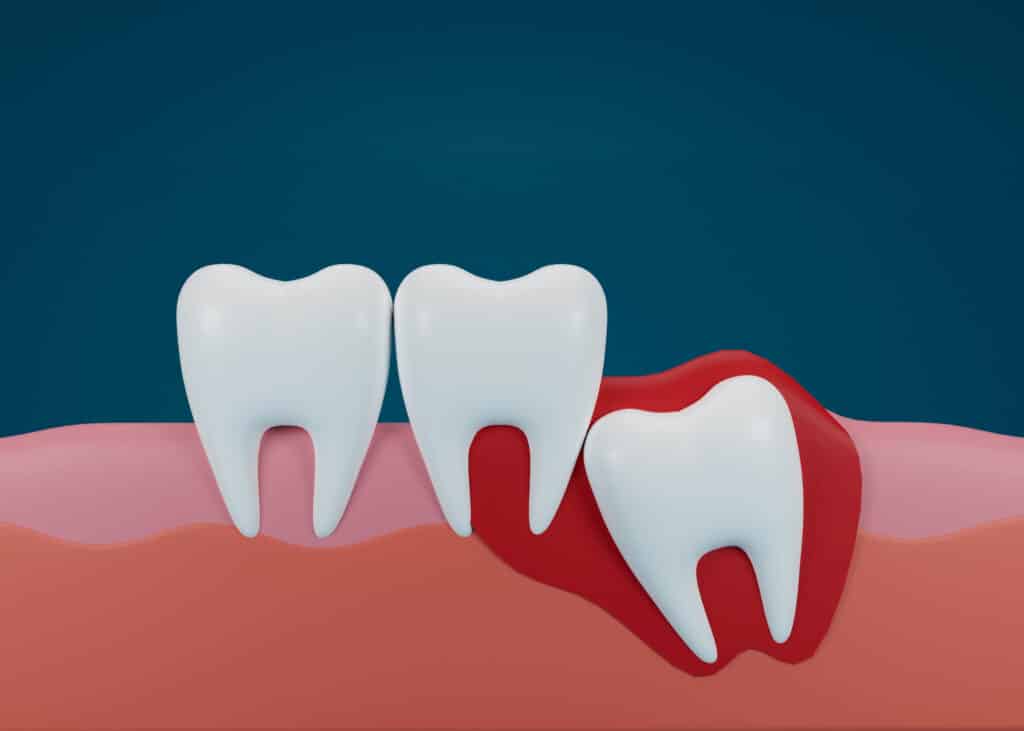
Special cases: partially erupted wisdom teeth
Partially erupted wisdom teeth are usually the most problematic:
- A "pocket" is created between the tooth and the gum where bacteria accumulate.
- They are practically impossible to clean properly
- They are at high risk of recurrent pericoronaritis.
- May cause persistent bad breath
- Generate recurrent infections that can spread
These cases usually require more urgent attention to prevent acute complications.
Our experience in wisdom tooth extraction
At Sonrisa Para Todos we have maxillofacial surgeons specialized in complex extractions of third molars:
- Advanced training in oral and maxillofacial surgery
- Experience in handling complex cases
- State-of-the-art technology for diagnosis and treatment
- Updated surgical protocols and evidence-based
- Minimally invasive techniques for faster recovery
- Focus on prevention of complications


Myths and facts about wisdom tooth extraction
- Myth: "If they don't hurt, I don't need to remove them".
Reality: Many pathologies associated with wisdom teeth develop silently, without evident pain until advanced stages. The absence of pain does not guarantee the absence of problems. - Myth: "Extraction is always extremely painful".
Reality: With modern anesthetic techniques and proper postoperative management, most patients experience only moderate and manageable discomfort. - Myth: "It is better to wait until they cause problems".
Reality: Preventive intervention in young patients offers multiple advantages and avoids complications that can be significantly more problematic in older adults. - Myth: "All wisdom teeth must always be extracted".
Reality: Each case is evaluated on an individual basis. Some wisdom teeth that have fully erupted, have adequate space and can be properly cleaned may not require extraction.
Financing available
We have financing facilities with the main entities in the country.

Frequently asked questions about wisdom tooth extraction
Is it necessary to extract all four wisdom teeth at the same time?
This depends on each particular case. In young and healthy patients, extracting all four wisdom teeth in a single session may be advantageous because it requires a single recovery period. However, in complex cases or according to the patient's preferences, they can be extracted in quadrants (two on one side and then the other two).
How long is the recovery time after a wisdom tooth extraction?
Most patients experience swelling and discomfort for 3-5 days, during which time it may be necessary to modify diet and activities. Complete recovery of bone tissue may take 3-6 weeks, although after the first week most return to normal activities.
What happens if I decide not to remove my impacted wisdom teeth?
Impacted wisdom teeth can remain asymptomatic for years, but there is a permanent risk of developing complications such as infections, cysts, second molar caries or dental crowding. The risk of pathologies increases with age, and complications tend to be more severe in older adults.
Can the extraction of impacted wisdom teeth affect oral sensitivity?
The lower wisdom teeth may be in proximity to the inferior dental nerve. In complex cases, there is a small risk of temporary sensory disturbance. This risk is minimized by careful surgical planning with advanced imaging studies and surgeon experience.
At Sonrisa Para Todos, we transform complex procedures into comfortable and safe experiences.

 English